April 25, 2020
Every child's story has intricate roots
Source: Original magazin
To develop our own personality in order to provide our children with a happy childhood requires a lot of effort and even more ease. Through emotional awareness and play in her many years of work, Anita Marković takes children and parents on an adventure of family relations with her long-term.
What is the role of parents? Why is play important for children? Interesting techniques that we can apply regardless of age. These are the topics by which Anita Marković reminds us how to find and nurture a playful child in ourselves.
"I can present myself as a Master of Special Education who has been educated in various fields, so today I can say that I am a therapist in the field of dream analysis by interview method, a transactional analyst (TA) in the field of psychotherapy and a therapist who deals with spiritual healing techniques of ThetaHealing and Timeline Healing. However, what I like most to say is that I am a mum who has built all her knowledge and skills into a relationship with her daughter Lira. I would like to present briefly how I, as a therapist, have weaved my knowledge into the parenting process and relationship with my daughter, but also in my working with ‘my’ other children", Anita tells us.
Every child's story has intricate roots that go deep and often into the strange darkness of unresolved family events.
Dolores Munari Poda
Therefore, it is of utmost importance that parents' attention is actively focused on the prevention of creating matrices of negative beliefs and feelings in their children.
Today, knowledge on this topic is widely available through the scientific works of Bruce Lipton, Joe Dispenza, Gregg Braden, and many others who state that we are the ones who create our reality with our thoughts.
Childhood is the place where it happens most often, primarily due to lack of information, immaturity, misunderstanding of events in the family environment, and different conditions and starting positions of children.
How would you define the role of parents in a child's life?
Parents are key figures who can help children grow into people who will have as few contaminated beliefs about themselves, others, and the world as possible, and thus get a better chance to grow up living in accordance with their greatest potentials.
I believe that parents can see the individuality and uniqueness of their child best because they are the ones who know the child's strengths and weaknesses best.
By being included in their child's world, parents build an unbreakable bond of trust, intimacy, and love, not only in relation to the child, but at the same time in relation to their inner Child who can now experience and go through some missing experiences from their childhood.
Thus, parents become natural "therapists" to both their Inner Child and their own child. I believe that being aware of this, parents have a better chance of leaving some old and inherited sets of messages of negative aspects of the Critical Parent, which would contribute to, as Hedges Capers says, children "daring to live, and communication interruptions being drastically reduced."
This does not change the need for involvement in the psychotherapeutic process, but can be a way for this need not to arise at all or, if the help of experts is necessary, for parental action to be in harmony and congruence with the treatment process and teamwork of therapists, parents, and children.
What guides you in your work with children?
In my work, I have been guided by my intuition, being spontaneous and creative in choosing the appropriate approach and techniques in order to provide the child with appropriate affirmations and permissions so as to develop motivation through a positive attitude, verbal and non-verbal responses.
"Words, drawings, play, movements, and physical interactions, as well as the creation of 'healing stories', as Poda states, form the basis for providing tenderness, understanding and permission to children to be children, as well as to safely discover their feelings and thus share their world with their parents.
What does play mean to a child?
The most fruitful resource in establishing contact and developing a relationship full of support, understanding, and respect is through play.
Whenever I would come across interesting ideas, I would incorporate them into my work and repertoire of creative ideas to be more interesting, to be able to approach the child and make the best possible connection through which we can move together towards their psychological well-being and healing, at the same time learning how to allow my Inner Child to play, explore and create.
I would like to list several interesting ways how parents can enrich their time spent with their children and thus allow themselves to learn something new about their children and about themselves as well.
Psychological exercises through drawing and visualization according to the recommendations of Violet Oaklander
Our world in colors, shapes and lines
"Let's close our eyes together and imagine our world in colors, lines, and shapes. It doesn't have to be anything real – we will use shapes, lines and colors to evoke our world. Then let's draw what we have imagined. "
After this invitation to play, the child draws for themselves, and the parent draws for themselves, or all family members can play. Everyone can ask each other to explain and depict what is happening on paper in their world of colors, shapes, and lines.
"Let's see now what colors we have used... What is our world like? How much space does each thing on paper take up? Where did we put ourselves? We can give voice to the shapes to see what they have to say. Imagine that you are a part of your world. Is there anything in your world that worries or frightens you? What can we say to our worries and disappointments? What is it that is cheerful and beautiful in our world? What can we say to our joys and feelings of happiness? What is that strong line in your world? Is there anything in your life that doesn’t allow you to do the things you want to do? Imagine that person is here and tell them, or if that person is one of us – feel free to tell them now.
Family drawings
Let's play with our family's drawings as if we were symbols or animals.
"Close your eyes and go to your space. Imagine each member of our family. If you drew them on a piece of paper as something they remind you of, and not as real people, what would it be? If someone in your family reminds you of a butterfly because they flutter around a lot, is that how you would draw them? Or maybe they remind you of a circle because they're always around you… Start with the one who you think of first. If you get stuck, close your eyes and go back to your space. You can use lumps of paint, shapes, objects, and things, animals, or anything you can think of.”
A game of curves
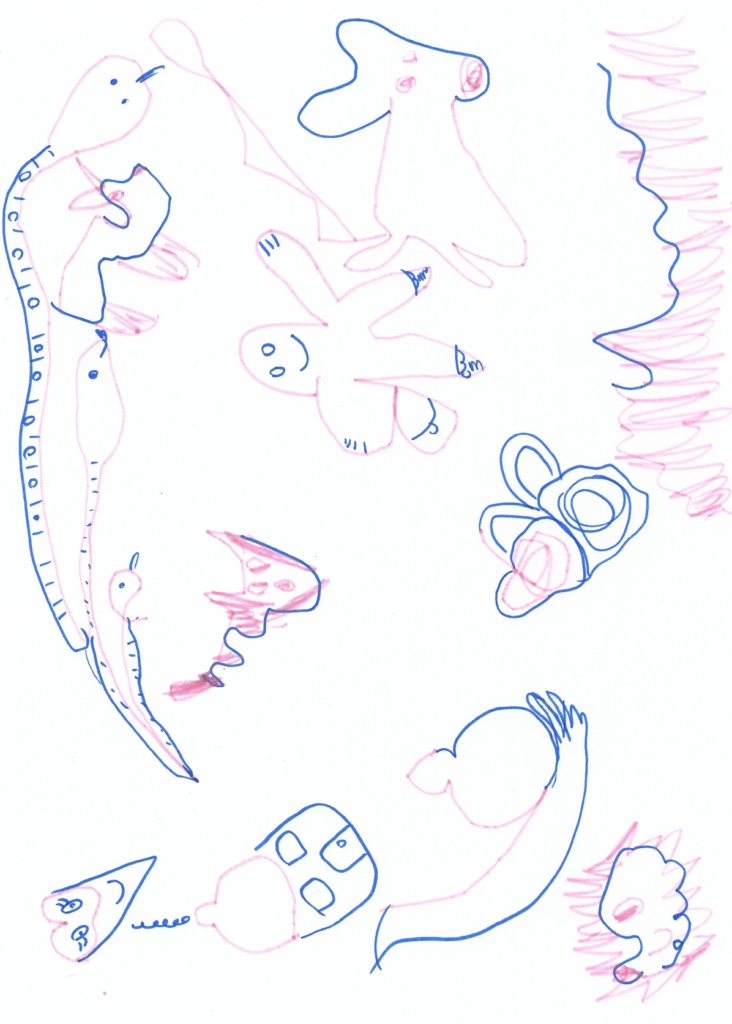
Everyone chooses their color. We choose who starts first. For example, the parent closes their eyes and draws a curved line in blue on a blank piece of paper. The child makes a drawing of their own color out of that blue curve drawn by the parent. Then they change roles and now the child closes their eyes and draws their pink curve, and then the parent makes a drawing out of it with the color they want.
As the procedure continues, they tell each other about the drawing and then another material appears.
We meet
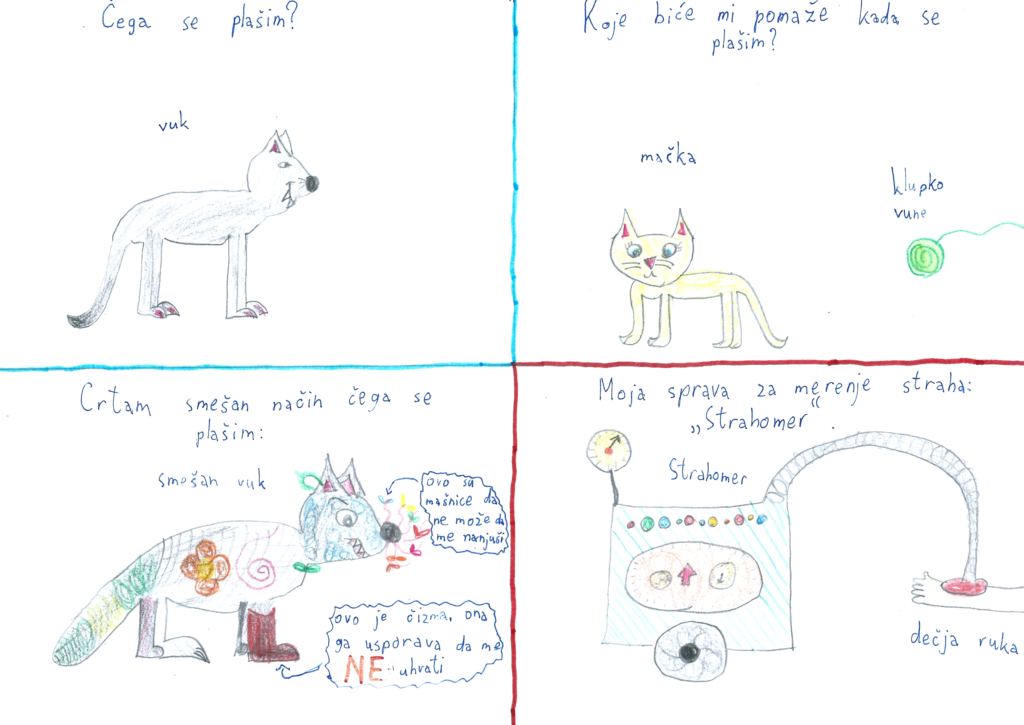
Lira's presentation of neutralizing fears
(Draw how you feel when we can't go out because of the coronavirus.)
Prepare a large figure of a child on paper, with the following instructions: "Draw how you imagine your body in colors, shapes, lines. With your eyes closed, imagine yourself in front of you.”
Draw something you don't like me doing, and I'll do it too.
Draw something that worries you or that scares you.
Draw three wishes.
Have the child say what the parent should draw, and then the parent draws it.
Laughter as the best medicine
Indian doctor Madan Kataria designed the yoga laughter as a combination of deep breathing and laughter exercises that cause a person to be as playful as a child. Laughter creates strong bonds between those who laugh together, which activates new and positive feelings in our subconscious.
Playful laughter games affect us to look at a situation differently when we encounter it in real life, and then we are no longer programmed to panic and stress, but to laugh and find a positive solution.
Laughing can help children cope more easily with stress and with the emotions accumulated within themselves. These exercises help to alleviate inhibitions and shyness, so our fake laughter grows into unconditional, honest, and open one.
The benefits of yoga laughter exercises in working with children are multiple: increasing energy, improving mental attitude, improving the quality of interaction, developing better contact and willingness to learn, be innovative and creative, reducing problems with discipline, increasing motivation, and strengthening connections. I'd single out a few examples, and ask parents and children to use their imagination and come up with some of their own types of laughter.
Chatter
The language of sounds, i.e. gibberish nonsense words with no meaning – can flow fast or slow; on a given topic we are expressing happiness, anger, fear, or sadness; one of us begins, and the next one continues from the last they remember, and so on.
Milkshake laughter
Hold an imaginary glass filled with strawberries in one hand, and a glass full of bananas in the other hand. We mix the ingredients and drink with loud sounds of pleasure and laughter – everyone suggests their own combination.
Laughter of a mental floss for cleaning the head
Thoughts, emotions, laziness, and the like can be cleaned. We pretend to pull the imaginary thread through our ears and clean them with laughter – it is preferred to say what is being cleaned: bad thoughts, prohibitions, and other things. When we're done, we pull out the thread and throw it away or burn it.
Bird laughter
We act like a chicken, a rooster, a penguin, and a condor laughing, and in the end, we hug each other laughing all the time.
Rowing laughter
Everyone is sitting behind each other with their legs wide apart as if we were in a big boat. We check out loud if everyone is ready, and then we can talk about how we are going down the rapids, the water splashes, we are leaning to the left and to the right, and then let us all fall backwards over each other with laughter.
How would you describe the process of raising an emotionally literate child?
Parents and guardians are the most important figures in children's childhood, so children adopt emotional patterns and behavior from them.
I think it is a matter of hygiene for us as adults to deal with ourselves and our growth and development. There are many different ways, so I wouldn’t talk about them now. What is certain is that a stable parent is a source of real support in the development of their child.
I will single out some important guidelines that I mostly learned from Claude Steiner, one of the most important authors in the field of transactional analysis:
• Provide support so that the child understands why he or she feels the way he or she feels.
• Develop empathy in children, so that if they accidentally hurt someone, they can apologize for that.
• Be honest with kids!
• Don't hit a child!
• Feel free to hug and love children, with lots of saying how much you love them.
• Be patient and consistent in the things you teach them.
• What if the parent makes a mistake in their behavior due to their current weakness - for example, if they shout, or when they get angry they will not pay attention to the child? It is never too late for a parent, when ready and emotionally stable, to return back to that moment to apologize and explain why they reacted that way.
• Understand and accept your children's feelings.
• Use emotionally literate media: books, movies, plays, and more.
• Teach children emotional self-defense, so that they learn to respect their boundaries in a nice way and to have the right to refuse what they don't like: "I don't like that. Please stop. I do not like it". Use dolls and toys and practice different scenarios by thinking of different situations.
• Allow yourself to enter the children's world of imagination and dreams and be grateful for that privilege.
Text: Jelena Drekić

